
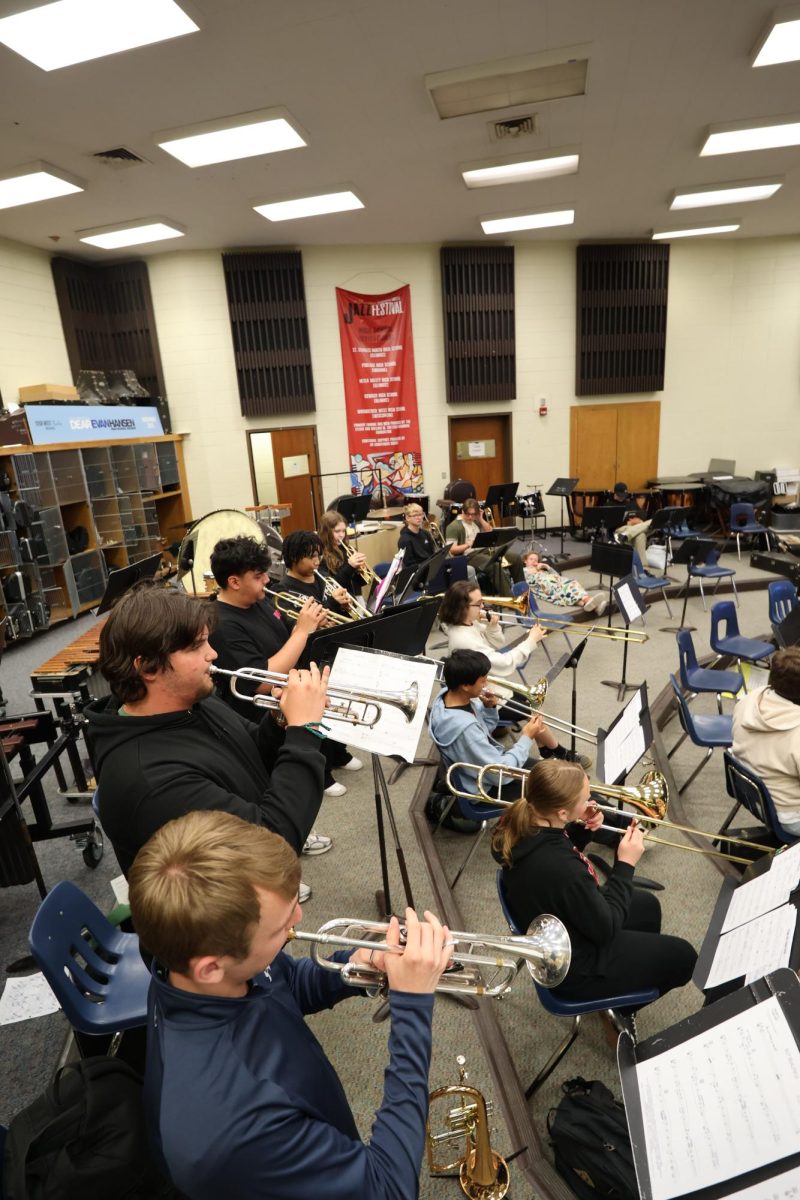
Four AP classes, Science Bowl, chess club, and tennis matches. For Tosa West senior Max Kuhn, a schedule like this should be a recipe for burnout. Yet, like fellow senior Ben Nowacek, Kuhn has found a way to turn the chaos of senior year into perfect harmony.
For these two student-musicians, the intense discipline of practice isn’t just an extracurricular distraction, it’s the exact tool driving their academic success.
Carter Simmons, the Artistic Director of the Milwaukee Youth Symphony Orchestra (MYSO), says that “this connection is biological.” He also says that studying music seriously makes “an increasing number of neural connections within the mind,” which makes students who are uniquely wired to handle the challenges of the classroom.
To do well in school while also doing well in other areas, you need to be very organized and have what Simmons calls “acquired discipline.”
Kuhn is taking four AP classes and uses music as a way to get away from it all.
“When I have a long or hard assignment, I practice to get my mind back on track,” Kuhn says.
He carefully plans his day so that he can fit band in with other demanding activities like Science Bowl and Chess Club.
“I usually try to get my practice in before 10pm, especially with sax and clarinet, to not wake my parents up” said Kuhn.
Ben Nowacek sees his time as always moving. His work in theater and orchestra makes his schedule change every day, so he has gotten into the habit of getting things done ahead of time. This proactive approach lets him stay productive during short periods of time.
“I can have anywhere from 5 free hours to only 20 minutes on any particular post-school day, depending on that calendar,” Nowacek says.
Simmons notes that the “technical skillsets required to make an instrument function properly naturally lead to a young person who knows how to focus and be responsible. These traits help students deal with complicated schedules that would be too much for most other students.”
There is a strong intellectual connection between the music room and the classroom.
According to Simmons, the connection between the brain and music is biological.
“Musicians relate quickly to well-taught subjects in history and structural subjects throughout the sciences and mathematics, as all hemispheres of the brain are grown and used with great intensity,” said Simmons.
Simmons’ claims are backed up by a 2023 University of Southern California research study called,
“Researchers Find Music Education Benefits Youth Well-Being”
One of the Authors, and Associate Professors of Music Education at USC Thornton, Beatriz Ilari says “Music might be an activity to help students develop skills and competencies, work out their emotions, engage in identity work and strengthen connections to the school and community.”
Kuhn plans to major in Applied Mathematics for the 2026/2027 school year and notices this bridge every day. He points out that music theory is based on patterns and logic. “Music helps me solve problems the same way I will in many of my math classes.” (Kuhn)
For Nowacek, who wants to work in public policy in the future, the benefits come from being able to talk to people. He thinks that music has taught him to “listen beyond the baseline meaning,” which is an important skill for figuring out what people really mean in civics and theater. Simmons backs this up by saying that “studying music gives you the skill to break down complex tasks, structures, and problems to come up with a great solution.”
The pandemic fundamentally altered the musical journey for the Class of 2026, all of it starting in 6th grade.
Simmons noted that while COVID initially caused a decline in enrollment, he believes schools supporting music education will produce the most successful students of this generation.
Kuhn says that the pandemic hurt aspiring musicians by taking away the social connection that comes with being in an ensemble.
For Nowacek, however, the effect was even stronger, and it was the main reason he left high-level commitments like MYSO.
Despite these interruptions, Simmons sees a revival. He says that musicians who go through these tough times come out as “empathetic problem solvers” who know more about how groups work and how to deal with their own feelings than most people.
As graduation gets closer, these two seniors’ paths start to diverge, but the “acquired discipline” Simmons talks about is still a big part of who they are.
Kuhn plans to continue his musical journey by joining the Yale University Marching Band or Orchestra while pursuing his applied mathematics degree.
Nowacek, however, will take the “wisdom and patience” he learned from playing the cello with him into the public arena.
Music gives these students a unique academic edge, whether it’s figuring out the “math” of a complicated music theory worksheet or keeping track of a busy rehearsal schedule.
“Music makes students smarter and gives them the ability to self-regulate their expressions and work well with others to come up with great solutions.”