

When the USS U.S. Grant sailed into the Manila Bay, Ethel Thor stood at the rail, her flaming red hair alive with wind. She was assigned to Manila, Philippines to be a U.S. army nurse during WWII. Orphaned as a child, she grew up with an older sister in Tacoma, Washington. The next day, Ethel reported for her first day of work as a military nurse. Little did she know her life was about to change, drastically. Ethel was one of 77 women who would eventually be known as the angels of Bataan and Corregidor for her bravery, grit, and professionalism while being put through prison camps, starvation, and disease, and yet every single nurse survived.
Nursing was perceived as a scandalous occupation for young women fresh out of high school. As the author Mary Cronk Farrell wrote in her book Pure Grit, “virtuous unmarried women were expected to remain ignorant to male anatomy and the nature of sexual relations.” Many mothers felt ashamed of their daughters’ chosen career paths. Nursing was such a “novel” concept, according to author Lena Andrews in her book Valiant Women. This was especially odd, as women had been nursing in wars since the revolutionary war. Despite the stigma, girls swarmed nursing school, as it gave an opportunity for women to support themselves.
Most women were stationed in the Philippines in hospitals like Sternberg hospital in Manila, on the eastern shore of the Philippines and Cañacao Naval Hospital in Cañacao Bay, on the northeastern peninsula. These women signed up to be peace-time nurses, however when the Japanese attacked, they were unprepared. Farrell writes, “Despite their lack of readiness for war, the nurses plunged in with mind, body, and heart.” One nurse, Margret “Peggy” Nash, described one Japanese bombing on Cañacao as a “nightmare”. As the casualties streamed in, Peggy also mentioned that “sometimes we would come to a bed [to ready the patient for surgery] and the patient was already dead.”
By December of 1941, Japanese planes were constantly flying overhead in Manila, and the girls’ supervisor, who was requested out of retirement by the U.S. military, General MacArthur realized he had to evacuate his nurses to Bataan. “That’s the first time most of us had ever heard of Bataan,” said Hattie Brantley, a farm girl from Jefferson Texas. At 5:30 on Christmas Eve of 1941, the twenty-five young army nurses made history by being the first American nurses to be ordered into combat. The women arrived at the U.S. Army General Hospital No. 1, however, you could hardly call it a hospital. As John Glusman states bluntly in his book Conduct Under Fire, “to call it a hospital was like calling a hut a hotel.” Despite the open-air environment, the women had a peaceful evening listening to the waves crash against the shore of Bataan.
The same could not be said for Navy nurse Madeline Ullom, who rode with her patients by boat to Corregidor Island. They arrived at the Philippines last line of defense, The Rock. A mega-underground base built in the 1920’s. By Christmas day, the army nurses had settled in Bataan. It was a day of preparing the hospital for casualties and cleaning surgical tools.December 26th, a day after Christmas, was back to the old routine. The Japanese bombed, and the nurses would work 24-hour shifts to prepare soldiers for surgery and give them morphine shots.
Eventually, the casualties overwhelmed the staff, so the army built another hospital, U.S. Army General Hospital No. 2 (Creative, I know). Josie Nesbit was appointed to supervise the new hospital. Josie operated the hospital with an iron hand, but the girls who knew her knew she was a softie. So much so that the Filipino nurses took to calling her “Mama Josie”. Josie was born in 1894, and according to Mary Cronk Farrell, “knew hard work like an old friend”. Having Josie around boosted morale and she advocated for the women to get tents, instead of just open-air quarters. By March of 1942, the nurses and soldiers went on half-rations. They started suffering from beriberi, a disease from vitamin B1 deficiency, dysentery, and malaria. These problems stemmed from malnutrition. Cooks started putting carabao (a native antelope), monkeys, and geckos into soups.
The chief nurse at Hospital No. 1 said that if necessary, the nurses will “eat one meal every two days”. By April 3rd, Good Friday for Christians, the Japanese had bombed their largest assault yet– three thousand men were sent to the hospital that day. The Monday after Easter, the Japanese had started bombing the hospitals, 73 men were killed and 117 wounded. No nurses died, but two nurses followed the Navy nurses from Cañacao to “The Rock”, or Corregidor island.
Josie Nesbit, the supervisor of Hospital No. 2, received the news before the rest of her “girls”. The nurses would be evacuated the night of April 8th, to go to Corregidor. Josie was told that all of the American nurses would go. Now, there were numerous Filipino nurses who also worked with her, the women who nicknamed her Mama Josie. So, Josie told her supervisor, “If my Filipino nurses don’t go, I’m. Not. Going.” She convinced the army to allow all the nurses to go, and they left for the island.
Josie’s group arrived at Corregidor at six am, and many of the nurses were so exhausted, they just slept immediately. One woman used her helmet as a pillow and fell asleep in the middle of the floor. Corregidor was hot and stuffy, and despite the fact that “The Rock” was literally impenetrable, that didn’t stop the Japanese from trying. One particular bombing incident killed 14 men outside, and 100 were seriously wounded. The doctors were so swamped they permitted nurses to perform minor surgeries. Nurses and doctors even had to donate their own blood! April 29th, 1942, Josie Nesbit, Rita Palmer, Sally Blaine, and 17 other nurses were called down by their officers. They were going to be sent to Australia on the first available transport. The girls were shocked, and Josie went so far as to refuse to go. According to the article The Angels of Bataan: The World War II Nurses Who Survived Three Years in a Japanese Prison Camp the women chosen were women “who were ill, injured, or otherwise unlikely to be able to withstand lengthy captivity.” The girls left for the land down under, yet the rest of the nurses stayed. Despite the gruesome and downright disgusting conditions, the nurses knew they were doing “essential work” according to Lena Andrews. On May 2nd, the Japanese hit Corregidor with their worst shelling yet, over 1.8 million pounds of explosives hit The Rock.
On May 6th, General Wainwright sent out men clutching white flags. By the end of Corregidor, there were “300 air raids and one of the heaviest artillery bombardments of World War II during a grueling siege.” according to Conduct Under Fire. Nurse Inez McDonald remembered, “I was scared spitless.” At the time of the surrender, 1,500 men were being treated by the nurses. By the end of the war, only 280 of those men lived. Madeline Ullom remembered, “nearly everybody had bacillary dysentery. Many of the girls had malaria.” Madeline had come to Corregidor with the rest of the Naval nurses, in 1941. The patients and nurses now have become prisoners of war, or POWs.
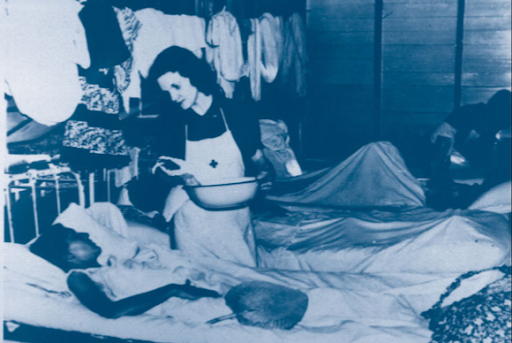
On July 2nd, the Japanese decided to take the nurses and their patients to the Santo Tomas internment camp. The women enjoyed riding the boat and finally being out of The Rock, however, the internment camp came with its own set of problems. The women had zero privacy. The Japanese soldiers were free to come and go as they pleased, and Peggy Nash, a Navy nurse, was followed around by a soldier for days before he snapped a picture of her caring for a POW. The image is shown above. If someone escaped, there would be a spectacle made of it. By Christmas of 1942, the women were suffering from boredom or, as nurse Denny Williams called it, “great mental and emotional fatigue”. However, the holiday lifted their spirits some, when the Red Cross sent out a care package with food for the prisoners. This package was greatly appreciated by the nurses, who were struggling to stay afloat with the meager rations they were given.
The navy nurses were transferred to a different prison camp in May of 1943. They put sixty to a boxcar and the women rode the six hours to the Los Baños Health Resort. The nurses operated as normal, treating their patients throughout the day and grasping for sleep at night. By December of 1943, though, rations were cut and quarters became cramped as the Japanese attempted to fit more prisoners in Los Baños. The nurses became fatigued, and their clothes started to wear.
Meanwhile, in the Santo Tomas prison camp, the army nurses weren’t doing much better. The Red Cross had supplied Christmas gift bags for the nurses, but the Japanese slashed open most cans and inspected every inch of the package, before giving the nurses the rest in the afternoon. By 1944, Los Baños prison camp, where the navy nurses were being held, had expanded again to 1,600 prisoners. They had only two meals a day, and many of the nurses suffered from beriberi, largely due to malnutrition. This was the same story at Santo Tomas. Nearly 80% of all prisoners had beriberi, and many nurses had too. By late January of 1945, the Japanese soldiers started stealing from the patients’ gardens because they too were starving. The American soldiers had started to close in, and air raids became frequent.
On the dusk of February 3rd, 1945, a voice called out into Santo Tomas, “Hello, folks!” The voice was undeniably American. The nurses were overwhelmed and overjoyed. The soldiers shared their rations with the prisoners and the prisoners had their first decent meals in years. This image shows the army nurses shortly after being relieved for duty and flying to Australia to be hospitalized and rest. The nurses then were flown to Hawaii, and finally to the U.S. Many nurses reunited with their sweethearts and family members, but some nurses, like Denny Williams and Rita Palmer learned that their husbands and fiances had not survived.
Three weeks later, Los Baños was also freed by Americans. In the early hours of February 23rd, 1945, the camp was raided by Filipino and American soldiers. 2,147 people, civilians and military personnel were freed. The naval nurses had a similar situation to the army nurses, where they were able to simply “get on with their lives”, according to Farrell. Lots of women were suffering from beriberi and tuberculosis, so much so that one nurse, Peggy Nash received a life expectancy of five years. This was disproved, as she lived to 81 years old, eventually passing away in 1992. The women, home at last, could finally have a moment of peace and tranquility– their first in three years.
These women were remarkable. Strong, resourceful, and valiant. The nurses faced challenges that were nearly impossible to overcome. They remained professional throughout bombing, imprisonment, and illness, all while caring for their patients and preserving their dignity. These women not only survived it all themselves, but also kept their prisoners safe, and remarkably, in the internment camps they had a mortality rate of 5.8%, an incredibly low number, largely due to the women’s medical care. The nurses were nothing short of incredible, and their story shines brighter than the angel wings they’ve been coined for for all their admirable work.