

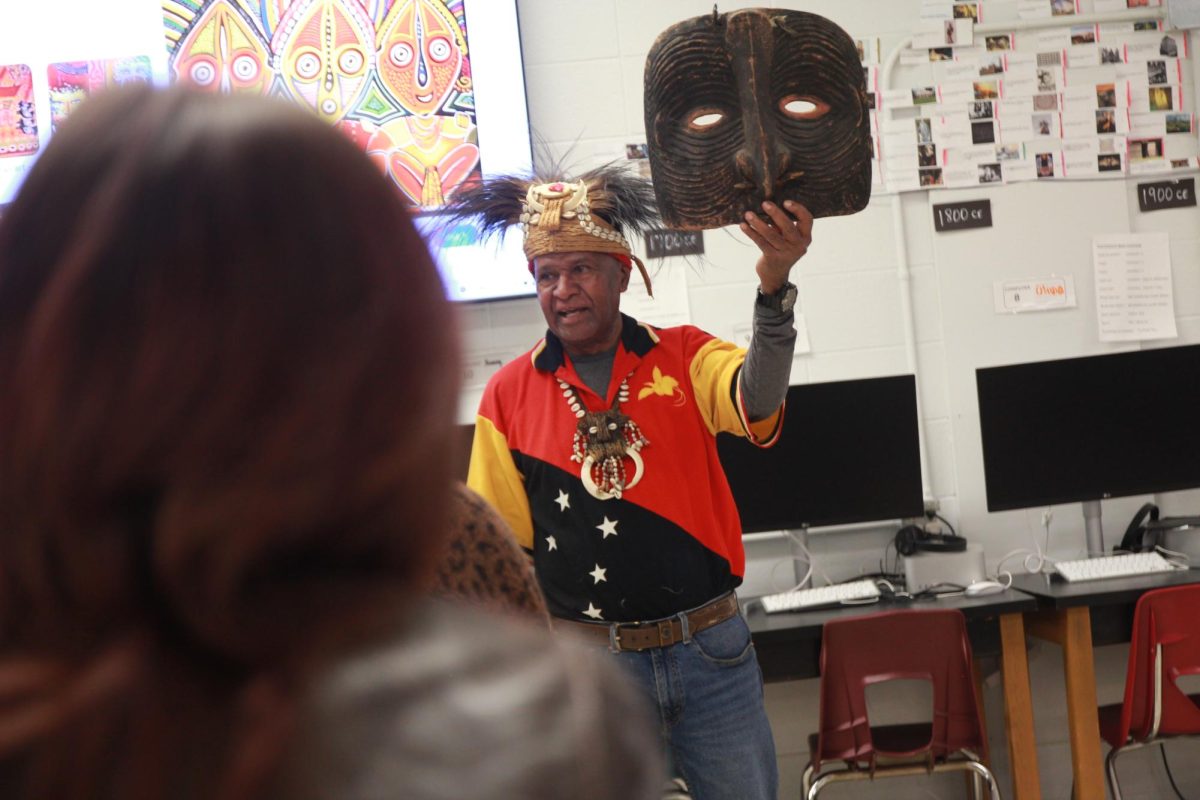
Aral Nen, a Papua New Guinea tribal chief and longtime Tosa West substitute educator, recently visited a fourth-hour AP Art History class to share his tribe’s traditions and artistic practices with students. The presentation took place on Tuesday, March 24.
For the past three weeks, the class has been studying the art and history of the Pacific Islands. To deepen their understanding of tribal art pieces, art teacher Jessica Belich invited Mr. Nen to present his tribe’s history, products, and cultural practices.
A Legacy of Diversity
Mr. Nen began by walking students through the complex history of Papua New Guinea. He explained the impact of colonization, noting that his home country has been shaped by shifting borders and foreign influence.
“We are the same people, but the colonizers cut the border in between,” Nen explained. “We were colonized by the Germans, and then by the Australians after World War Two.”
Papua New Guinea is home to over 800 distinct tribal groups, each with its own language and traditions. Mr. Nen’s own heritage is a blend of two distinct backgrounds: his mother is from the mountain-dwelling Seik tribe, and his father is from the coastal Sangak tribe. As the chief of the Yonggomugl tribe, Nen holds a deep responsibility to honor both sides of his lineage.
“When I visit the country, I have to make sure I visit my dad’s place first, jump on a bus to go way up into the mountains, and then go visit my mom’s tribe,” Nen said. “If you go to one side already, other people will complain. You have to ensure you respect both regions equally.”
Art as a Spiritual Practice
While Papua New Guinea’s tribal diversity is vast, Mr. Nen noted that modernization and city life are creating challenges for the younger generation. As youth migrate to urban centers, the traditional knowledge of crafting, language, and art is at risk of fading.
To combat this, Nen shared the historical significance of his tribe’s art. He explained that before Christian missionaries arrived, many tribes held deep spiritual beliefs centered on nature and their ancestors. Sculpture was not merely decorative; it was functional.
He presented a small wooden statue of a man to the class, explaining its purpose: “Before Christianity, people believed in nature—the mountains, the caves, or the stones that protected the village. The belief was that families would place this statue outside their door at night. It would prevent bad spirits from entering, and the family would sleep peacefully. Then, in the morning, they would take it back inside.”
Nen also shared a lesson his father taught him about the importance of speaking the tribal language when entering sacred jungle spaces.
“You can’t go and speak a foreign language,” he told the students. “You have to speak the tribal Sangak language. You talk to the jungle first, so they know you are a member of the tribe. If you don’t, you’ll be in trouble. In our tradition, that ‘trouble’ means the rain and thunder will come to chase you out.”
From the Earth
Because the Yonggomugl tribe believes that nature is the highest power, their artistry relies entirely on materials found in the local environment—earth, plants, and animals. By showcasing these handcrafted items, Mr. Nen provided the students with a tangible connection to the art history they have been studying.
His visit served as a reminder that behind every artifact in a museum or textbook, there is a living culture, a history of survival, and a set of beliefs that continue to shape the world today.